

One of the major factors that has set apart companies from each other is the delivery of an exceptional customer experience (CX). Whereas products and pricing were the main tools for competitive strategies, the spotlight has now moved to customer understanding predicting their needs, preferences, and expectations. Business analytics is the main instrument of the change. By converting data into useful insights, companies can tailor the customer journey, simplify operations, and customer loyalty can grow indefinitely. This article discusses the role of business analytics in enhancing customer experience and explains the importance of analytical skills development through top-notch programs like XLRI courses for professionals and businesses to be able to maintain their competitive advantage.
Introduction: The Rise of Data-Driven Customer Experience with XLRI Courses
In today’s business scenario, enterprises interact with customers through various digital and physical means. Each click, purchase, feedback, and support interaction results in a huge volume of data. However, this data is only useful when it is analyzed properly. Business analytics is the tool that organizations need to link this data, understand customer behavior, and offer such experiences which customers feel are specifically for them.
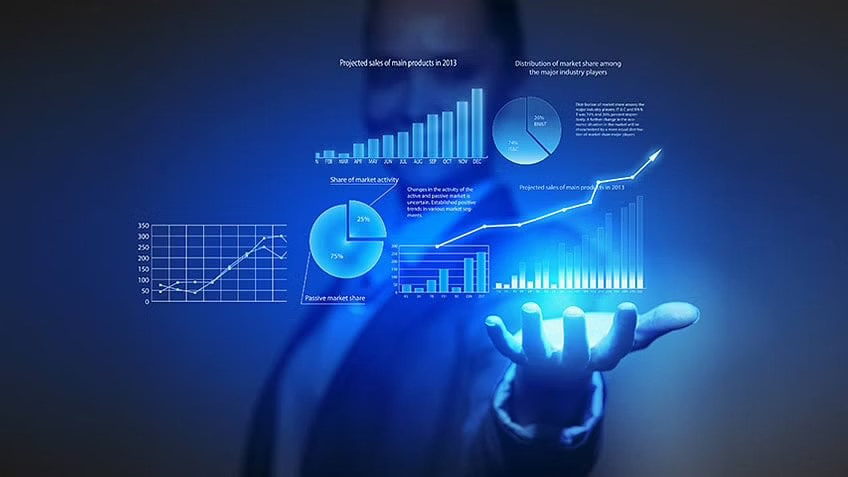
Practitioners with high-level skills in analytics are turning into the main drivers of customer experience-related changes. To satisfy this requirement, a lot of companies are motivating their employees to upgrade their skills through certified XLRI courses that merge analytical skills with the strategic customer-centric approach of thinking. This way, companies become not just the ones who understand customer needs but also those who take the lead in acting on the insights.
How Business Analytics Enhances Customer Experience
1. Personalized Customer Interactions
Customers of today demand personalization, relevant recommendations, tailored offers, and valuable communication. Business analytics facilitate the companies to segment their customers by using:
- Purchase history
- Browsing behavior
- Demographic data
- Engagement patterns
As an illustration, Netflix, a streaming service, recommends the content based on what the user has watched, while e-commerce brands provide product suggestions based on a shopper’s previous purchases. The personalized interactions lead to the customer being more satisfied and having a stronger emotional connection to the brand.
2. Enhanced Customer Journey Mapping
Knowing customers’ movements through the sales funnel is vital for the improvement of service delivery. The use of analytics tools leads to mapping the entire journey – from awareness to post-purchase engagement – and pinpointing the areas of:
- Confusing website navigation
- Slow delivery timelines
- Inconsistent customer support
By these findings, companies have the opportunity to make their processes not only more efficient but also more customer-friendly, faster, and intuitive in experience at all levels, i.e., touchpoints.
3. Real-Time Responsiveness for Improved Service
With real-time analytics at hand, companies are given the power to meet the customers’ demands on the spot. Among the most responsive tools such as chatbots, recommendation engines, and automated notifications are those that rely on fast data processing. Organizations are thus enabled to:
- Detect the problems right away
- Deliver the assistance on the spot
- Stop grievances before they become serious
The brand experience is not only enhanced but also deepened by this instant responsiveness, which eventually leads to trust being built.
4. Predictive Analytics for Anticipating Customer Needs
Predictive analytics is aimed at using historical data to predict the future. This ability allows enterprises to:
- Predict churn risk
- Initiate proactive loyalty programs
- Manage inventory based on consumption
- Formulate marketing strategies suitable for the future
For example, telecom companies and banks utilize prediction models largely to timely offer retention methods to customers who might leave them.
5. Voice of Customer (VoC) Analytics
Customer feedback, reviews, and social media mentions are rich sources of information on customer sentiment. With the help of sentiment analysis, businesses have the ability to:
- Monitor brand perception
- Discover the causes of customer dissatisfaction
- Alter products or services through the lens of verified insights
Knowing customer’s needs from their voice leads to increase in satisfaction and more profound brand loyalty.
6. Enhanced Decision-Making Across Departments
Customer experience is not only a marketing function; it is a matter that touches every business unit–from product development to logistics. By using analytics organizations are able to:
- Make decisions based on data
- Work together across teams
- Achieve operational efficiency that results in higher customer satisfaction
As an illustration, inventory optimization based on data allows customers to always have access to the products they need thus, the shopping experience is improved.
7. Cost Efficiency and Service Optimization
The use of analytics is a great help to organizations in their endeavors to provide luxurious experiences to consumers without the need for enormous expenses. By pinpointing what is of the utmost importance to the customers, brands can manage to:
- Cut costs in areas that have little value
- Step up the game by experience-enhancing initiatives
- Increase marketing and support functions ROI
Proper resource allocation is an assurance of top-notch service provision.
Business Analytics as a Competitive Advantage
Data-driven organizations massively outperform those that merely guess. The use of data to drive decisions is the core of success for any business whether it is a global leader like Amazon or a fledgling digital startup.
Major competitive advantages include:
- More intimate customer relationships
- Increased retention and loyalty rates
- Enhanced brand image and reputation
- Expansion of both revenue and customer base
With the competition becoming fiercer, customer expectations will keep on increasing. Only companies that have strong analytics capabilities will still be able to provide excellent experiences on a regular basis.
Building Business Analytics Expertise
With rapid advancements in AI and data technologies, there is an increasing need for professionals who can:
- Translate data into customer insights
- Design experience-improvement strategies
- Implement analytical tools and automation systems
- Drive CX transformation within organizations
This trend has prompted many working professionals and fresh graduates to pursue business analytics and customer-focused programs at leading academic institutions. These programs are designed to develop technical analytics skills along with managerial thinking and strategic acumen, which are essential for a customer-first transformation.
Conclusion
Business analytics is fundamentally changing the way companies work with customers, making each interaction a chance to add value. Through personalization to predictive insights, analytics allows companies to give customers experiences that are effortless, pleasing, and prepared for the future. Since companies are using customer experience more and more as their main competitive weapon, it is necessary to have strong analytical capabilities.
By XLRI online courses of good repute, professionals can enhance their skills and thus be able to connect analytical knowledge with practical business applications, thereby becoming the most valuable contributors to customer experience innovation. In a data and digitally oriented world, those who can harness analytics effectively will lead the transformation toward exceptional, customer-centric growth.